> For the complete documentation index, see [llms.txt](https://docs.mastersindia.co/masters-india-gst-software/llms.txt). Markdown versions of documentation pages are available by appending `.md` to page URLs; this page is available as [Markdown](https://docs.mastersindia.co/masters-india-gst-software/introduction/reconciliation/gstr-1-vs-sales-register-reconciliation.md).
# GSTR-1 vs Sales Register Reconciliation
Matching Between GSTR-1 and Sales to make GSTR-1 more accurate.
## **How to Configure the Reconciliation?**
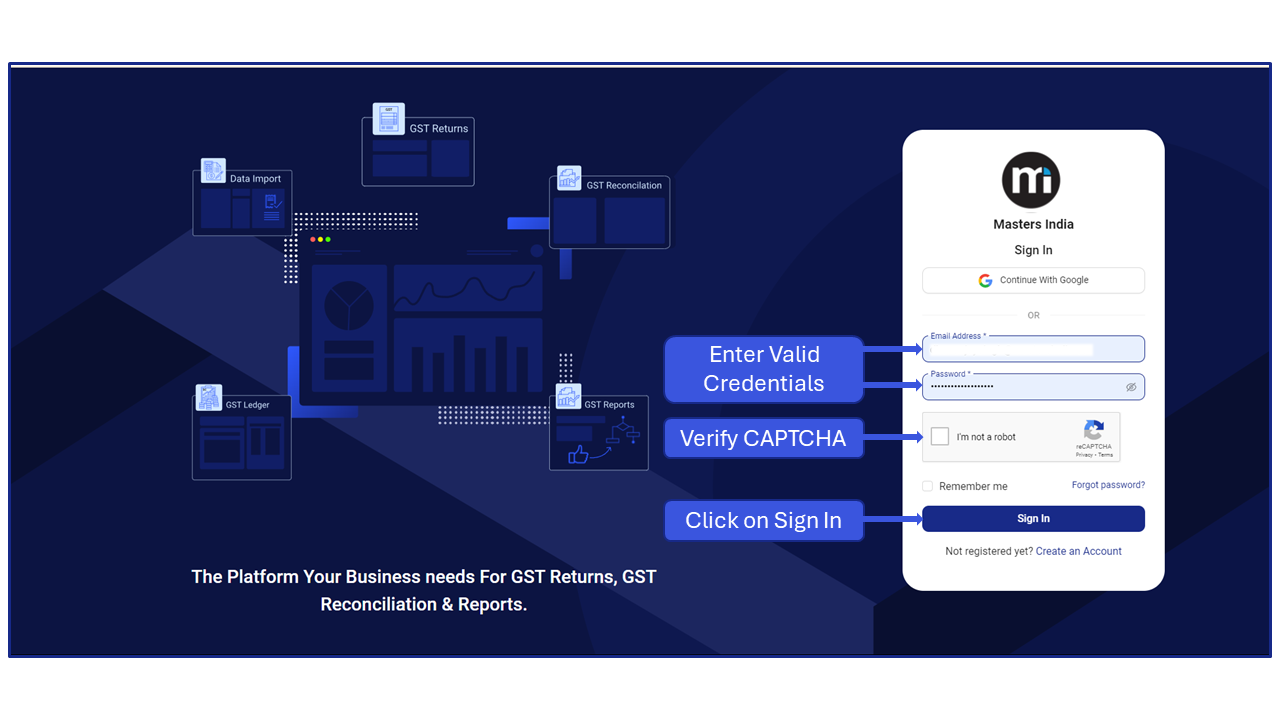
**Step 1**: Log in to Masters India GST Software with valid credentials then click Sign In.
**Step 2**: After Sign-In - 'Dashboard' will appear - click on the 'GST Reconciliation' module from the left Navigation Bar.
**Step 3**: Click on GSTR-1 Vs Sales Register ‘View Reconcile’ tab
**Step 4**: Click on the "Configure New Reco" button.
**Step 5: Add configuration details to run the reconciliation job**
1. The user can select the custom return period for GSTR-1 as shown below
2. Select Sales Register return period
3. Users need to select GSTINs from the drop-down, for which they want to execute the reconciliation on a regular basis
4. Users need to select a frequency for auto-reconciliation by clicking the drop-down.
5. Users can select the Start Date for Reconciliation.
6. Users can select a time to Start reconciliation.
7. **Segregated by GSTIN checkbox**: In case a user has multiple registrations and wants to submit a job separately for all their GSTIN, the user can select this checkbox.
**Note**: Preferably, we ask users not to select the checkbox to get results for all their business units under a single Job
8. **Buffer Tax Value**: A tax tolerance or threshold value a user can input according to their business operations.
9. **Buffer Taxable Value**: It is a taxable tolerance value or taxable threshold value a user can input according to their business operations.
**Step 7**: After clicking the 'Submit' button, the user will be redirected to the Job list page, which will mention the serial number of jobs and their GSTIN along with other details.
## **Reconciliation Reports**
**'Download' Button:** The user can click the "Global Download" button on the top right corner to get Reconciliation Reports 'Consolidated Reports' or 'Vendor Wise Summary Report
### **Consolidate Reports**
This is an overall consolidated report of the reconciliation performed, where the user can get Invoice-Level-Wise (both GSTR-1 and sales register) bucket segregation of Invoices. This includes all the invoices users who participated in the reconciliation.
### **Section Wise Summary Report**
It is a report containing all unique vendors and their status according to GSTR-1, Sales Register & Reconciliation. In other words, the system will generate a summary that will provide values against each GSTIN present in GSTR-1, Sales Registers, Match, Mismatch, Not Present in PR, Not Present in 1, and Invoice Number Mismatch.